
From Skyscraper Windows to AI Workplaces: 4 Powerful Reads Shaping the Future of Work in Germany and Beyond
Join the discussion on where work is headed

Dear friends, Dear readers,
I hope that this newsletter finds you well.
This edition I am trying spark some debate and discussion on the discussed articles. Please leave a comment or write me about your own experiences. I would love to hear your thoughts.
Also please make sure that others hear about this newsletter by forwarding it to your E-Mail contacts that you haven’t been in touch with. If every regular reader were to forward it, 400 more people would be reading this newsletter. That’s quite something.
Window cleaning & digitalisation: When reading an article on window cleaning in the European Cleaning Journal, I asked myself what this article tells us about the changing terrain that low-wage workers, such as cleaners, are operating in. While not explicit in the article, there are several leverage points to take note of. Maybe I am reading too much into it but it provides some interesting insights on how how labour processes are changing and at which points or around which issues workers might organise.
What articles have you read that surprised you with their level of insight? Where do you think workers currently have (under-utilised) leverage?

Human Resource Management and Low-wage work: The vast majority of Human Resource Management articles deal with subjects that pertain high-skilled or knowledge workers. Less attention has been paid to the HR strategies that companies employ to attract, recruit and retain low-skilled and low-paid workers. This academic article by Eva Herman, Jill Rubery and Gail Rebson provides an interesting account of how companies seek to respond to the perceived behaviour of the pool of workers they are recruiting from.
Do you or have you worked in a low-wage/low-skilled occupation and do you think HR followed a strategy? What kind of strategies and tactics did they employ to manage the workforce? What playbook were they following?
Unions in law and order-capitalism: Joern Boewe and Johannes Schulten write about a shift away from socio-ecological transition to a new period of militarisation in the wake of the CDU-SPD government in Germany. They argue that the new policies are impacting the balance of power between capital and labour, forcing unions to prepare for new conflicts. Labour market and migration policies are designed to discipline workers and their unions. The authors draw out how unions are responding to militarisation, developing industrial policies and organising workers. They come to the conclusion that on paper unions are seeking to meet the challenges but that there are contradictions organisationally.
What kind of labour market and migration policies are being put in place in your country? To what extent do they seek to discipline workers, and create divisions in the working class? Are unions responding to the challenges ahead?
Artificial Intelligence: In their paper for the International Labour Organisation Global case studies of social dialogue on AI and algorithmic management, Virginia Doellgast and her co-authors explore different cases in which workers and management have negotiated and bargained over artificial intelligence and algorithmic management in the workplace. The paper provides a strong overview of how unions are negotiating and bargaining across the globe. The examples focus on the impact on employment levels, the use of algorithmic management and working conditions. They find that the use of AI or algorithmic management can be ‘empowering’ for workers where employers cannot exit social dialogue arrangements. At the same time however they draw attention to all the new jobs being created, such as data labelling, data janitors, etc. where unions need to organise.
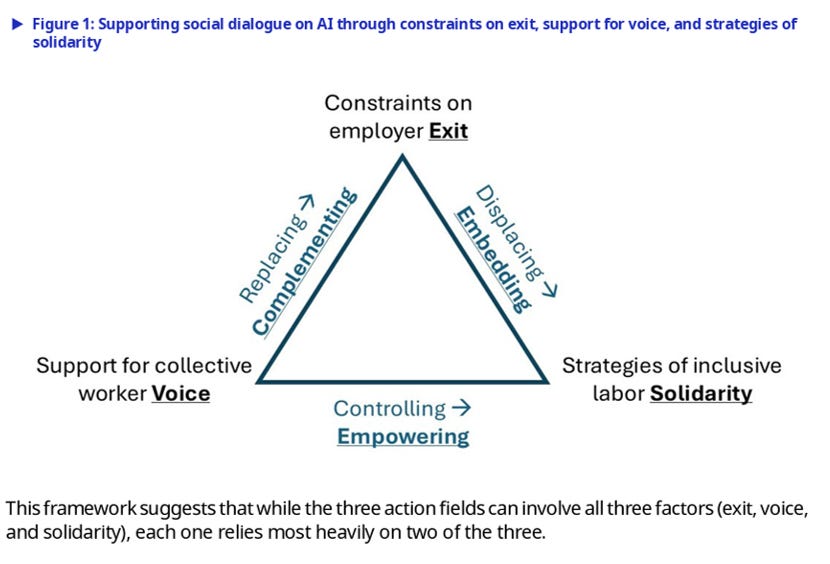
Do you think that workers have the power to contain artificial intelligence and algorithmic management? Do you think AI or algorithmic management can be ‘labour empowering’?
That’s it for now. I hope you enjoyed this week’s newsletter with links on the world of work and will contribute to the discussion.
I look forward to hearing from you.
Hugs,
Mark